Today, we’re tackling a topic that gets flooded with a lot of conflicting information, passionate opinions, and, frankly, a fair bit of smoke (pun intended). We’re asking the big question: When you consume cannabis, which of your organs is taking the biggest hit?
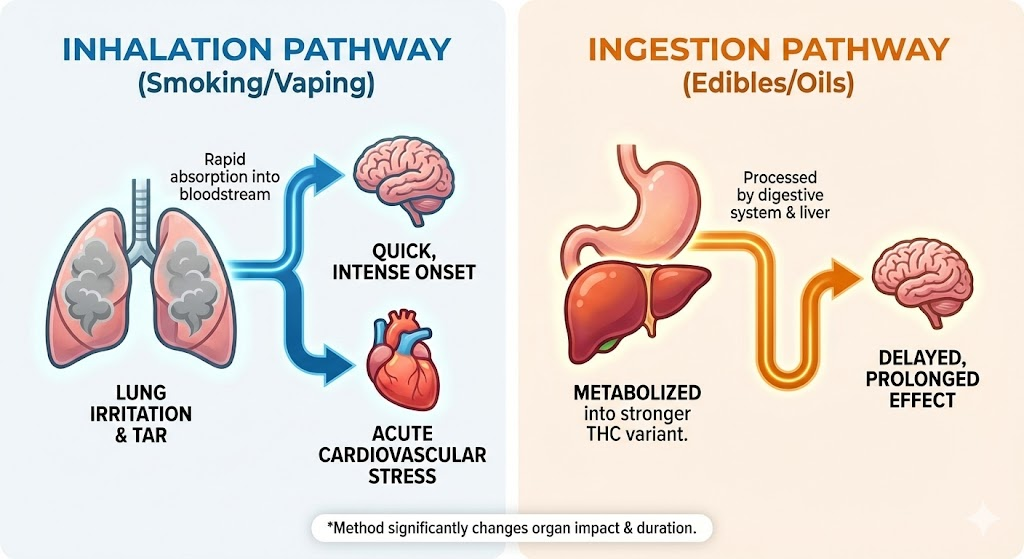
It’s a surprisingly tricky question to answer. Why? Because cannabis isn’t just one thing, and humans aren’t identical machines. How you consume it (smoking vs. edibles vs. vaping), how often you use it, your genetics, and the type of cannabis you use all play massive roles in how your body reacts.
Furthermore, the science is still playing catch-up. Decades of prohibition meant that high-quality, unbiased research was hard to come by. We are learning more every day, but there are still plenty of grey areas.
So, grab your coffee (or water, stay hydrated!), get comfy, and let’s take a tour of the human body to see how weed interacts with our internal systems.
The Visual Breakdown: Cannabis and Your Body
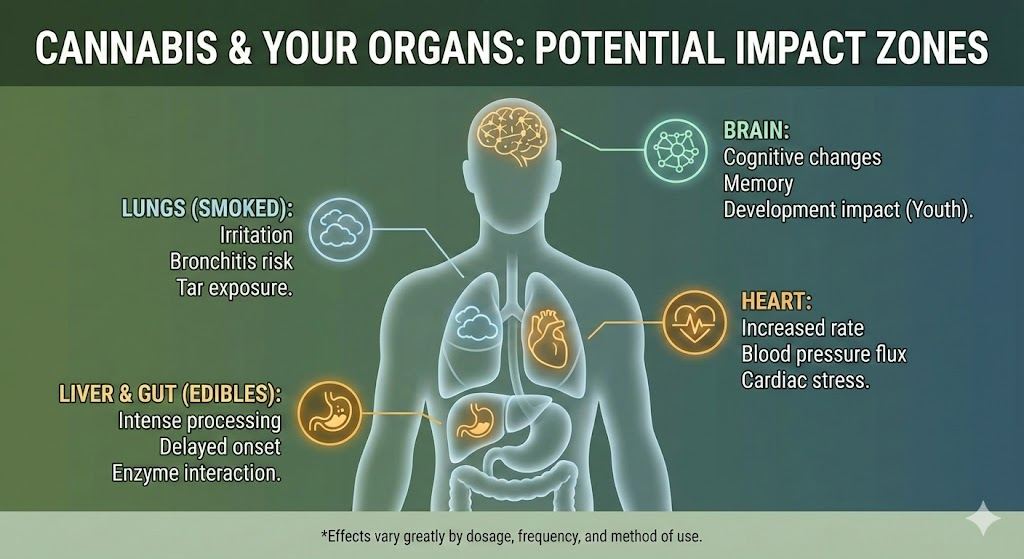
Before we get into the nitty-gritty details, let’s look at a high-level overview. It’s helpful to visualize where the major interactions happen.
The Effect of Cannabis on Your Major Organs
Okay, let’s zoom in. As we mentioned earlier, the reason cannabis affects so many different parts of you is thanks to the Endocannabinoid System (ECS). You have ECS receptors all over your body—in your brain, your immune cells, your gut, and your major organs.
When you introduce plant cannabinoids (like THC and CBD) into your system, they bind to or influence these receptors, changing how those organs function temporarily.
Here is a breakdown of what current science tells us about how cannabis interacts with the major players in your body.
The Effect of Cannabis on The Lungs
If you are smoking joints, blunts, or bowls, your lungs are absolutely on the front lines. This is the organ system that takes the most direct, physical hit from combustion.
It is crucial to understand that while tobacco and cannabis are different plants, smoke is smoke. Burning plant matter creates tar, benzene, and other carcinogens.
-
The Reality: Regular cannabis smokers often report more symptoms of chronic bronchitis than non-smokers. We’re talking coughing, wheezing, and phlegm production. The American Lung Association is pretty clear on this: inhaling smoke is harmful to lung tissue, period.
-
The Vaping Question: Many people switched to vape pens thinking they were “safe.” While they avoid combustion, vape cartridges can contain thinning agents or flavorings that are disastrous for lung tissue when heated and inhaled (remember the EVALI crisis?).
-
Deep Dive Link: Read what the American Lung Association says about Marijuana and Lung Health here.
The Effect of Cannabis on The Brain
This is the control center, and it’s also where the “magic” (or the anxiety, depending on your experience) happens. The brain is loaded with CB1 receptors, which is why THC has such potent psychoactive effects.
-
Short-Term: When you’re high, THC scrambles the brain’s ability to form new memories effectively, alters your perception of time, and slows down your reaction speed. This is why driving while impaired is a hard “no.”
-
The Age Factor (Crucial!): This is perhaps the most significant finding in modern research. The adult brain bounces back pretty well from occasional use. The adolescent brain does not. The brain is still under major construction until about age 25. Heavy cannabis use during these formative years has been linked to lasting issues with attention, memory, and motivation.
-
Deep Dive Link: The National Institute on Drug Abuse (NIDA) has extensive research on how marijuana affects brain development.
The Effect of Cannabis on The Heart
Many people don’t associate weed with heart issues, but cardiovascular stress is one of the most immediate physical side effects of getting high, especially for new users.
-
The Racing Engine: Within minutes of inhaling, your heart rate can speed up anywhere from 20% to 50% (sometimes even more). This increased rate can last for a couple of hours.
-
Blood Pressure Rollercoaster: Cannabis can cause your blood pressure to spike initially, but then drop quickly when you stand up (causing that dizzy head-rush feeling). For a healthy young person, this is usually manageable. For someone with underlying heart disease, that extra stress on the cardiac muscle can be risky. There are documented cases of cannabis triggering heart attacks in at-risk individuals.
-
Deep Dive Link: Harvard Health Publishing breaks down the connection between marijuana and heart health here.
The Effect of Cannabis on The Liver
Your liver is your body’s primary filtration and processing plant. Its relationship with cannabis depends almost entirely on how you consume it.
-
Smoking/Vaping: When inhaled, THC enters the bloodstream through the lungs and mostly bypasses the liver initially. The liver eventually cleans things up, but it’s not the primary stop.
-
Edibles (The Liver’s Heavy Lift): If you eat a brownie, your liver is the star of the show. It processes the Delta-9 THC and converts it into 11-hydroxy-THC. This metabolite is significantly more potent and crosses the blood-brain barrier more easily. This is why edible highs feel stronger and last much longer. While the liver is built for this job, combining high doses of edibles with alcohol or certain medications can put extra strain on the organ.
-
Deep Dive Link: Learn more about how the liver metabolizes drugs from this National Institutes of Health (NIH) overview.
The Effect of Cannabis on The Reproductive System
This is an area where researchers are urging caution, especially for those actively trying to conceive.
-
For Men: Regular, heavy cannabis use has been linked to lowered sperm counts and issues with sperm motility (how well they swim). Basically, it can make it harder to fertilize an egg.
-
For Women: Cannabis use can disrupt the menstrual cycle and impact ovulation. More critically, use during pregnancy is strongly discouraged by major medical organizations due to potential impacts on fetal development and birth weight.
-
Deep Dive Link: The CDC provides clear guidance regarding marijuana use and pregnancy/reproductive health.
The Effect of Cannabis on The Gut & Digestive System
We all know about the “munchies”—that’s your ECS creating a massive appetite surge. But the relationship between weed and the gut is complicated.
-
The Good: For decades, cannabis has been used to combat nausea, particularly for chemotherapy patients. It can settle the stomach effectively for many people.
-
The Bad (CHS): On the flip side, there is a paradoxical condition affecting heavy, long-term daily users called Cannabinoid Hyperemesis Syndrome (CHS). Instead of helping nausea, cannabis causes severe, cyclic bouts of debilitating vomiting and abdominal pain that is often only relieved by hot showers. It’s rare, but it’s miserable and real.
-
Deep Dive Link: Cedars-Sinai offers a good explanation of Cannabinoid Hyperemesis Syndrome (CHS).

Daniel Levinson – Cannabis Biz Dev Consultant
10 years of cannabis biz dev and marketing experience. Consultant to many leading cannabis brands and startups.