Almost every cannabis recipe is an ordinary recipe with one ingredient swapped: the butter or the oil. Get the infused butter right, know roughly how strong it is, and the same jar will make brownies, mac and cheese or a mug of hot chocolate. This guide covers the butter, the dosing math most recipes skip, and what to cook once you have it.
This is for adults 21 and over. Homemade edibles are easy to overdo, so read the dosing section before you bake anything.
Step one: decarboxylate the flower
Raw flower contains mostly THCA, which is not intoxicating until heat converts it to THC. A lighter does that instantly. In the kitchen you have to do it in the oven before the flower goes anywhere near butter. If you skip this step you will make a weak, grassy butter and wonder what went wrong.
The method below follows Leafly’s cannabutter guide, which was last updated in May 2026.
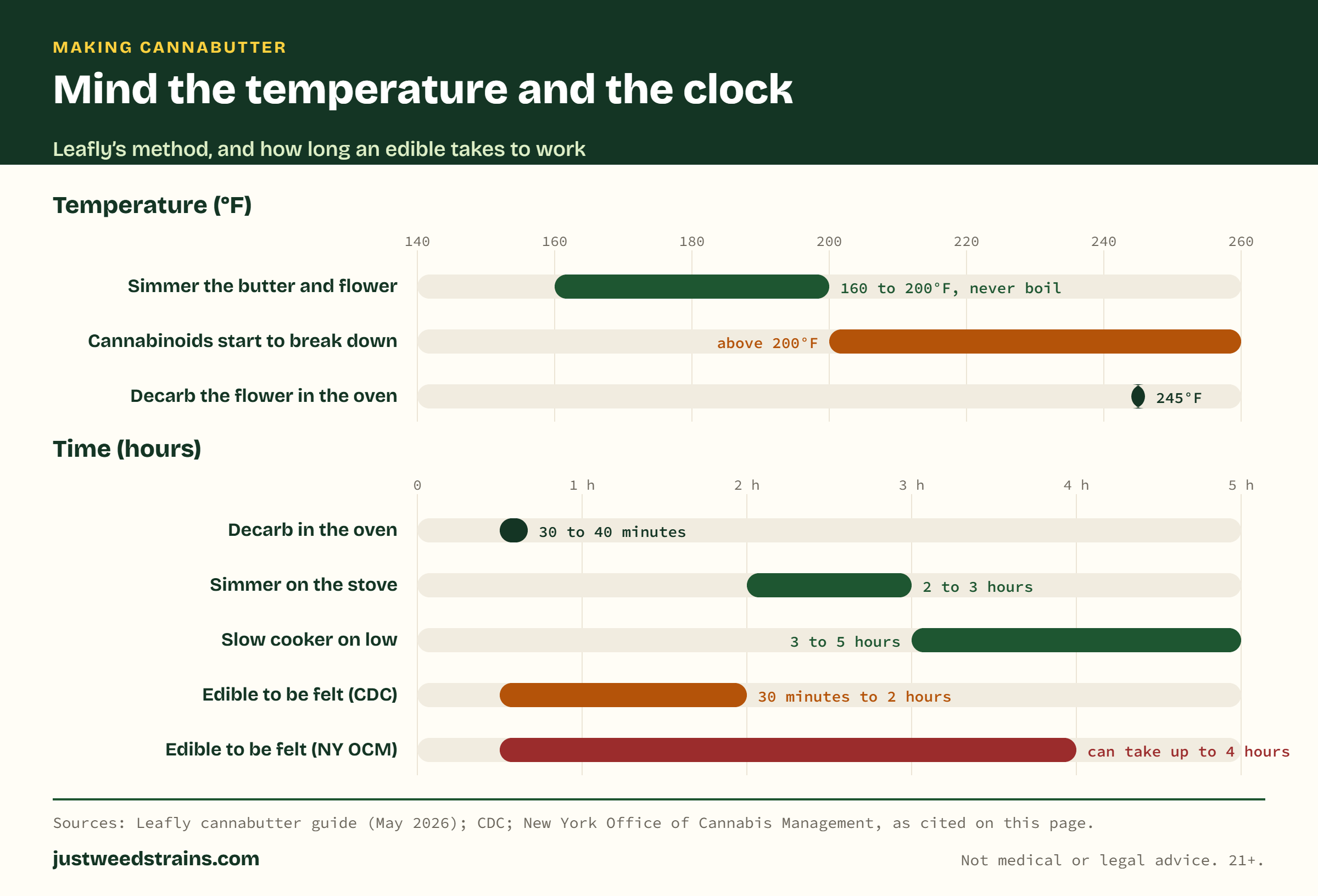
- Heat the oven to 245°F.
- Break the flower up loosely with your fingers. Do not grind it to powder.
- Spread it on a baking sheet lined with parchment paper.
- Bake for 30 to 40 minutes, stirring every 10 to 15 minutes, until it turns light brown.
Your kitchen will smell of it. Open a window.
Step two: make the cannabutter
You need:
- 1 cup of unsalted butter
- 1 cup of water
- 7 to 10 grams of decarboxylated flower
- A saucepan, a thermometer if you have one, cheesecloth and a container with a lid
- Melt the butter with the water in a saucepan over low heat. The water is there to keep the butter from scorching.
- Stir in the flower once the butter has melted.
- Simmer on low for two to three hours, stirring now and then. Keep it between 160°F and 200°F and never let it boil.
- Pour it through cheesecloth into the container. Let it drip. Squeezing the cloth pushes chlorophyll into the butter and makes it taste like lawn clippings.
- Refrigerate until the butter sets, overnight if you can. If a layer of water has collected underneath, lift the butter off and pour the water away.
A slow cooker on low for three to five hours does the same job with less watching. Coconut oil and olive oil can be infused the same way if you want something dairy free.
Leafly gives a shelf life of one to three months in an airtight container in the refrigerator and up to six months in the freezer. Label the container clearly. It looks exactly like butter.
Step three: work out how strong it is
This is the part that separates a good evening from a bad one. You can estimate an upper limit from the label on the flower.
Take 7 grams of flower labeled 20 percent THC. That is 7,000 milligrams of flower, and 20 percent of it is 1,400 milligrams of THC. One cup of butter is 48 teaspoons, so if every milligram made it into the butter, each teaspoon would hold about 29 milligrams.
| THC on the flower label | THC in 7 grams | Most a teaspoon of butter could hold |
|---|---|---|
| 15% | 1,050 mg | About 22 mg |
| 20% | 1,400 mg | About 29 mg |
| 25% | 1,750 mg | About 36 mg |
| 30% | 2,100 mg | About 44 mg |
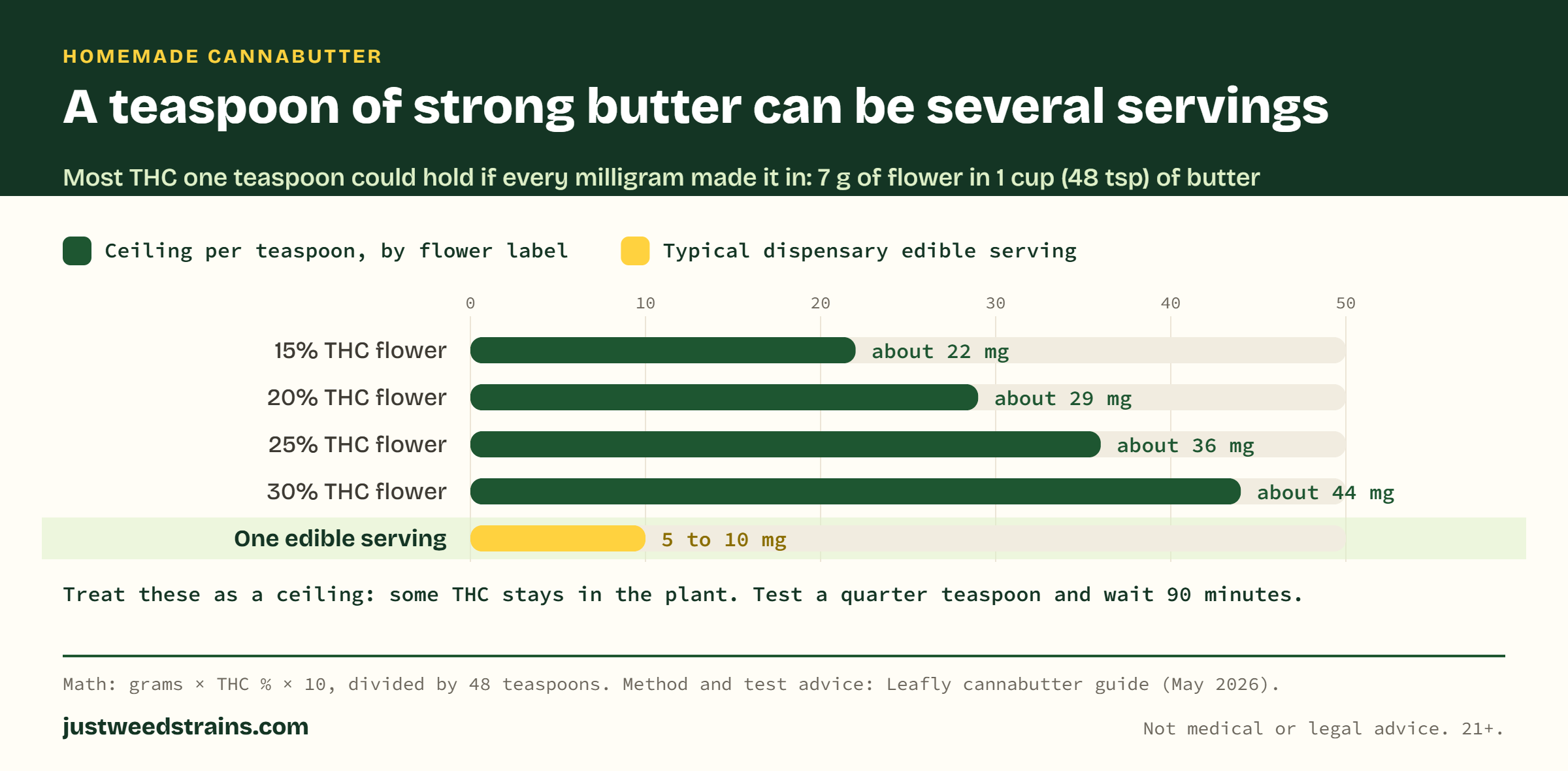
Treat those numbers as a ceiling. Some THC stays behind in the plant material, and Leafly says outright that the strength of homemade butter is hard to predict. For comparison, a single serving of a dispensary edible is usually 5 to 10 milligrams. A teaspoon of strong homemade butter can be several servings.
If your label lists THCA instead of THC, multiply by 0.877 first, because the molecule loses some weight when it converts. Our THC calculator does both steps for any weight and percentage.
Then test it on yourself before you bake with it. Leafly’s suggestion is to spread a quarter or half teaspoon on a cracker, wait 90 minutes and see how you feel. You cannot make a finished butter stronger, but you can always use less of it.
What to cook with it
Baked goods
Brownies and cookies are the classics because they already call for a lot of butter. Do not swap all of it. Decide the dose per piece, work out how much infused butter that takes, and make up the difference with regular butter.
For example, say you want 24 cookies at about 5 milligrams each. That is 120 milligrams for the batch. With the 20 percent butter above, 4 teaspoons gets you there, and the rest of the butter in the recipe can be plain. Mix the dough well so the dose is even from cookie to cookie. Baking is fine for the THC, because the inside of a cookie stays much cooler than the oven around it.
Savory dishes
Mac and cheese, mashed potatoes, garlic bread and buttered pasta all work. Stir the infused butter in at the end, off the heat. Do not fry with it. Leafly warns that cannabinoids start to break down above 200°F, and a hot pan goes well past that.
Drinks
THC dissolves in fat and not in water, so cannabutter will float on tea but blend into hot chocolate, a latte made with whole milk or anything with cream in it. Measure the butter the same way you would for food.
If you would rather buy a drink than make one, our guide to hemp and THC drinks in NYC covers the legal options and what they cost.
No cooking at all
The simplest recipe is a measured amount of cannabutter on toast. It is also the easiest way to know exactly what you took.
Five ways to ruin a batch
- Skipping the decarb. The butter will taste of cannabis and do very little.
- Letting the butter boil. You burn the butter and cook off what you were trying to keep.
- Grinding to dust or squeezing the cheesecloth. Both put plant matter in the butter, and it tastes like it.
- Eating a second piece after 45 minutes. The CDC says edibles can take 30 minutes to 2 hours to be felt, and New York’s Office of Cannabis Management says it can take up to four hours. Most bad experiences with edibles start with someone deciding the first one did not work.
- Leaving them on the counter. A plate of infused brownies looks like a plate of brownies. The CDC advises keeping cannabis products locked up and out of sight of children and pets. If a child eats one, call Poison Control at 1-800-222-1222, or 911 in an emergency.
Our article on how cannabis affects the body explains why eaten THC lasts longer and feels different from smoked THC.
New York rules worth knowing
According to the state’s Office of Cannabis Management, adults 21 and over can possess up to three ounces of cannabis and 24 grams of concentrate, and can use it in a private home. Using it in a car is not allowed. What you cook is for your own table: selling cannabis in New York takes a state license.
If you buy your flower from a licensed shop, the THC percentage on the label is lab tested, which makes the math above worth doing. Our NYC dispensary directory lists the licensed ones by borough.
Frequently asked questions
How much weed do I need for a cup of cannabutter?
Leafly’s recipe uses 7 to 10 grams of decarboxylated flower for 1 cup of butter. Use less flower for a milder butter, or mix the finished cannabutter with regular butter to dilute it.
Do I have to decarb weed before making edibles?
Yes. Raw flower contains mostly THCA, which is not intoxicating until heat converts it to THC. Baking the flower at about 245 degrees Fahrenheit for 30 to 40 minutes before infusing it does that conversion.
How strong is homemade cannabutter?
It depends on the flower. Seven grams of flower labeled 20 percent THC holds about 1,400 milligrams of THC. If all of it reached 1 cup of butter, each teaspoon would hold about 29 milligrams. Real batches come out lower, so test a quarter teaspoon first.
How long do homemade edibles take to kick in?
The CDC says edibles can take 30 minutes to 2 hours to be felt, and New York’s Office of Cannabis Management says it can take up to four hours. Wait before eating more.
How long does cannabutter last?
Leafly’s guide says one to three months in an airtight container in the refrigerator and up to six months in the freezer.
Sources
- Leafly, How to make cannabutter (updated May 5, 2026)
- CDC, Cannabis and Poisoning
- NY Office of Cannabis Management, adult-use information
Updated Oct 10, 2026: this guide was rewritten to include a full cannabutter method and dosing math. The earlier version listed dish names without recipes.
For adults 21 and over. Nothing on this page is medical advice.

The Just Weed Strains editorial team writes our strain profiles and consumer guides. Strain profiles summarize publicly available information, including breeder and dispensary descriptions. Effects vary from person to person, and nothing on this site is medical advice.