Cannabis deals are still getting done in 2026. What has gone missing is the big all-stock merger between public companies that used to make the news. Most of this year’s transactions are small and private, and they are built on earnouts and borrowed money, which tells you who has cash right now and who does not.
What Rescheduling Changed
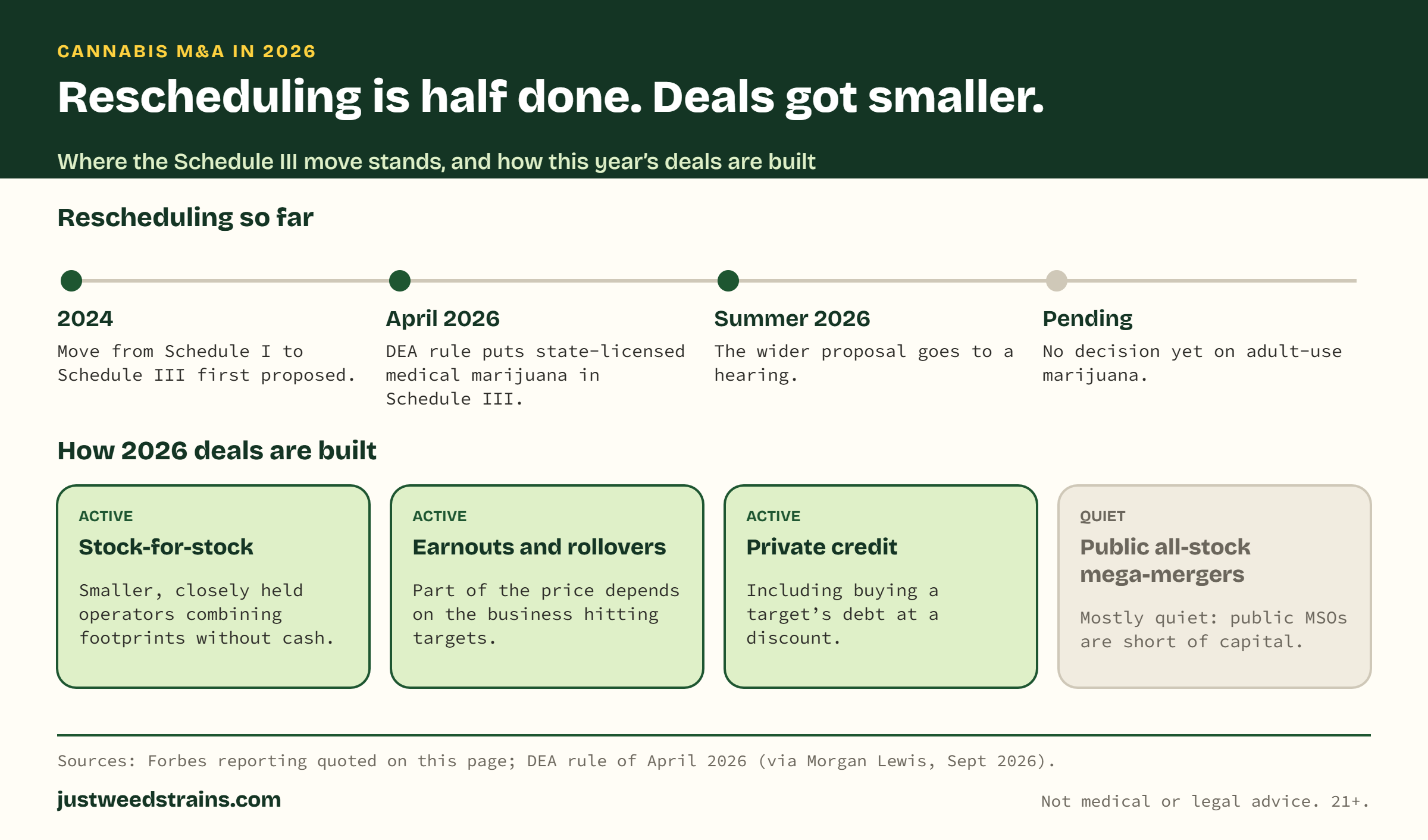
The move of marijuana from Schedule I to Schedule III, first proposed in 2024 and handled by the Drug Enforcement Administration, is now partly in force. In April 2026 the agency finalized a rule that puts state-licensed medical marijuana in Schedule III. The wider proposal went to a hearing over the summer, and a decision is still pending. Section 280E denies ordinary business deductions to companies that sell Schedule I and II substances, so whatever lands in Schedule III gets out from under it. For a profitable operator that is a large change in cash flow, and both sides of a deal are modeling it.
Better tax treatment does not create targets, though. A buyer still has to find a business worth owning, and that is where most of this year’s deal talk has stalled.
“A bad business will remain a bad business.”
Why Public MSOs Are Sitting on Their Hands
Multi-state operators (MSOs), the publicly traded companies that dominated cannabis M&A headlines a few years ago, are short of capital in 2026. Between debt loads, limited access to traditional bank financing, and stock prices well below their earlier highs, most public operators don’t have the cash or the currency to go on an acquisition spree the way they once did.
That’s a big part of why the big, public, all-stock mega-mergers that used to make headlines have mostly gone quiet. The buyers who would have led that kind of deal simply aren’t positioned to right now.
Where the Real Activity Is Happening
Consolidation is still happening, mostly out of public view. According to reporting from Forbes, most of the deal-making happening now is private, and it’s built on a different set of tools than the stock-swap mega-deals of the past:
- Stock-for-stock deals between smaller, closely held operators looking to combine footprints without a cash outlay.
- Earnouts and seller rollovers that tie part of the price to the acquired business hitting its targets, which pushes risk back onto the seller.
- Private credit, including buying a target’s debt at a discount, in place of the bank loans most cannabis companies still cannot get.
These structures let smaller operators, including licensed dispensary operators in tightly regulated markets like New York, combine or exit without needing a public acquirer or a large cash check.
“The early wave of the cannabis tsunami will be driven by structures, not by sentiment.”
A Year of Small Deals
The consistent read from people watching the space is that 2026 is a year of small, structured deals rather than transformative combinations. A few reasons that pattern is likely to hold for a while:
- Valuations are still resetting. Buyers and sellers haven’t fully converged on what cannabis assets are worth while adult-use cannabis is still federally illegal.
- The rules are half settled. Medical marijuana has been rescheduled and adult-use has not, and buyers are pricing that gap into every deal.
- Capital is scarce and selective. Whoever has clean access to capital, whether that’s private equity, family offices, or well-capitalized private operators, holds the stronger hand with sellers who need liquidity.
What This Means for Operators
- Sellers should expect terms as well as a check. Earnouts and seller financing mean the purchase price is rarely all paid on day one.
- Buyers with real capital access have the advantage. Cash, or access to private credit, is currently worth more in negotiations than it has been in years.
- Clean books and clean compliance get offers. Buyers can afford to be picky this year, and they are.

Frequently Asked Questions
Did cannabis M&A activity stop in 2026?
No. The large public all-stock mergers have slowed, but private deals built on stock swaps, earnouts and private credit have continued, according to Forbes.
Did Schedule III rescheduling cause a wave of cannabis acquisitions?
Not so far. The April 2026 rule covers state-licensed medical marijuana and improves the tax picture for the businesses it reaches, but it has not set off a surge in transactions. Buyers still want a business worth owning.
Why aren’t public multi-state operators doing more acquisitions?
Most public MSOs are capital-constrained, carrying debt and facing limited access to traditional financing, which leaves them with less cash and less appetite for large acquisitions than in previous years.

Daniel Levinson is a cannabis industry consultant and an advisor to Just Weed Strains. He has more than six years of experience in the sector, covering go-to-market strategy, regulatory compliance, licensing and capital raising, with a focus on the Israeli and international medical cannabis markets. He writes here on cannabis business, regulatory and dispensary topics.