New York legalized adult-use cannabis in 2021. Getting from “legal” to “open for business” took far longer, and for many license holders it is still not finished. This is how dispensary licensing works in the state, and why so many licensees are waiting to open or struggling once they do.
The Basic License Structure
New York’s licensing framework covers several categories beyond retail dispensaries, including cultivation, processing, distribution, and microbusiness licenses. For consumers, the one that matters most is the Adult-Use Retail Dispensary license, which permits a storefront to sell cannabis products like flower, vapes, and edibles directly to customers.
- Applicants go through a review process covering business structure, location, security plans, and social equity qualifications.
- The state has prioritized certain applicants, particularly through the Conditional Adult-Use Retail Dispensary (CAURD) program, aimed at people with prior cannabis-related convictions and their family members.
- Licenses are issued in waves rather than all at once, which is part of why the market has grown unevenly across the state.
Why CAURD Existed, and Why It’s Been So Hard
The CAURD program was designed to give justice-involved entrepreneurs a head start in the legal market. In practice, many CAURD licensees have described a much rockier path than the program promised, especially around financing.
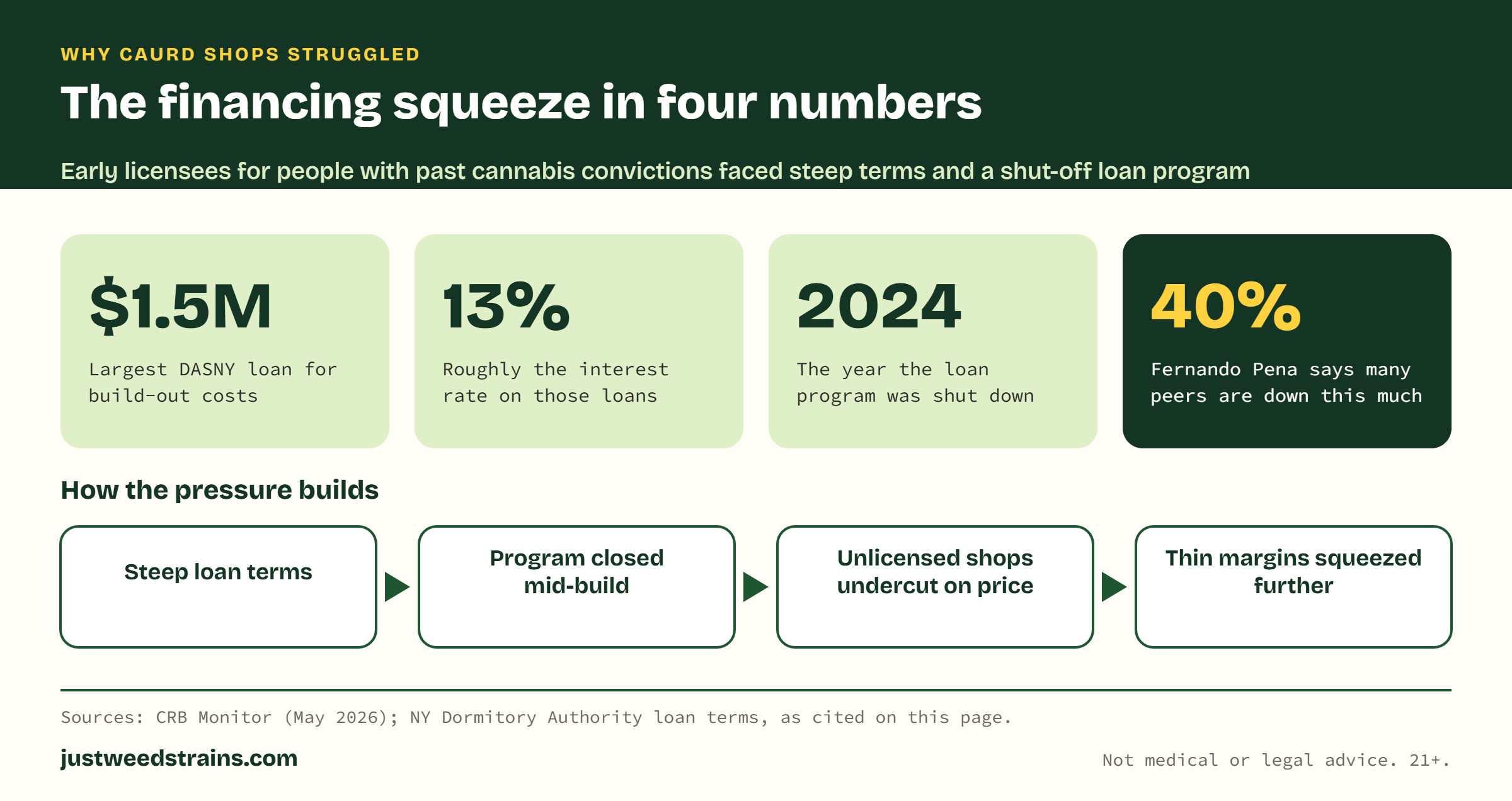
“A lot of my peers, including myself, are down 40%.”
Part of the problem traces back to financing. New York set up loans through the Dormitory Authority of the State of New York (DASNY) to help CAURD licensees cover build-out costs, but those loans carried steep terms.
- DASNY loans of up to $1.5 million came with roughly 13% interest.
- The DASNY loan program was shut down in 2024, leaving some licensees stuck mid-buildout.
- Illicit, unlicensed shops selling cannabis without a license have continued to undercut licensed dispensaries on price in many neighborhoods, squeezing already-thin margins.
“Everyone is getting paid except for us. We are living paycheck to paycheck.”
People who support the program’s equity design argue that speed was never the only goal.
“Equity is survival. It’s not just the licensing.”
How the Rollout Has Picked Up
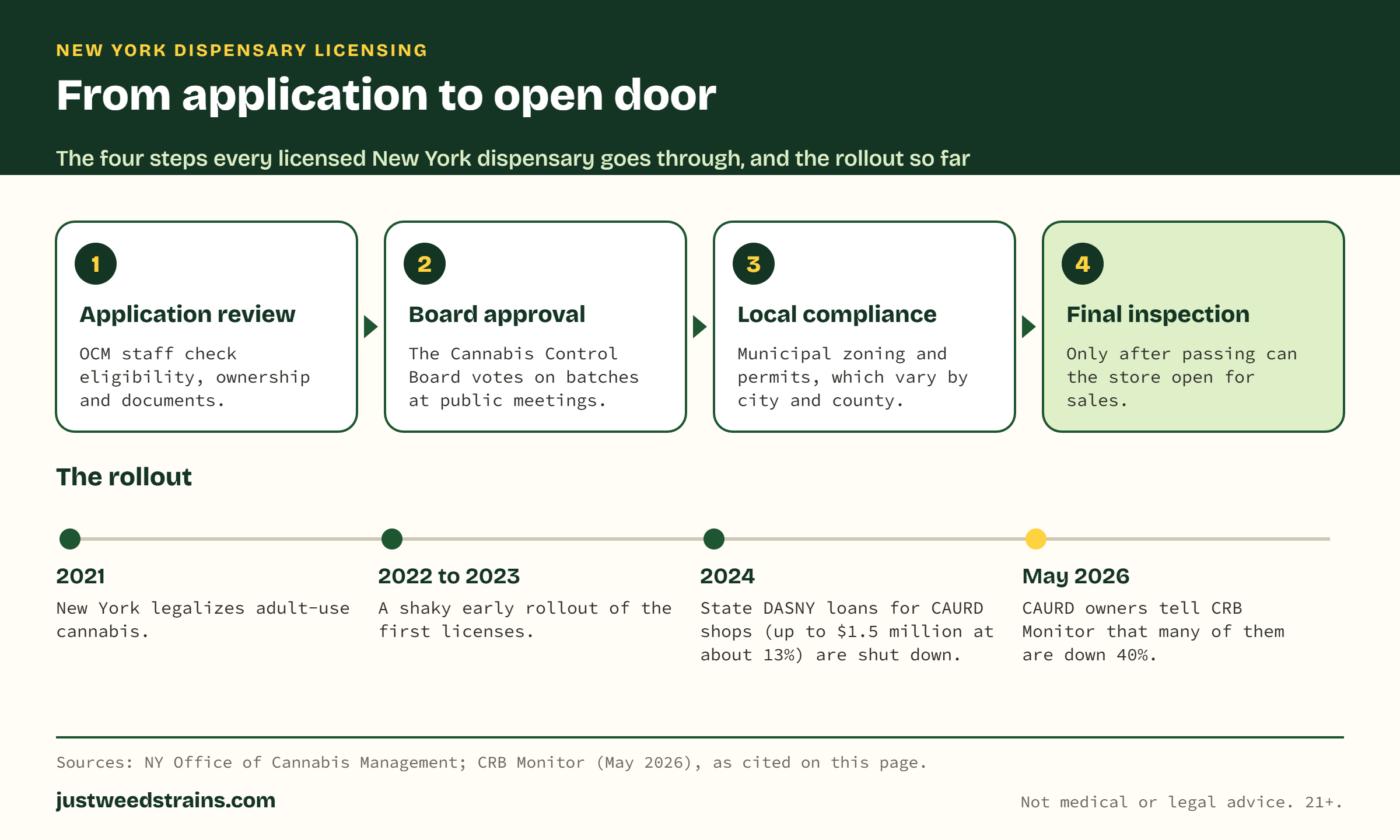
Despite the rocky early years, New York’s Cannabis Control Board has kept approving new licenses in batches. Each board meeting typically advances dozens of new applications, renewals, and appeals, gradually expanding the number of open storefronts across the state, including the shops in our borough by borough list of licensed NYC dispensaries.
- Application review. OCM staff verify eligibility, ownership structure, and required documentation.
- Board approval. The Cannabis Control Board votes on batches of applications at public meetings.
- Local compliance. Licensees still need to satisfy municipal zoning and permitting rules, which vary widely by city and county.
- Final inspection and opening. Only after passing inspection can a licensed store open for retail sales.
What This Means for Shoppers
- New York has far more licensed dispensaries than it did during the shaky 2022 to 2023 rollout, but coverage still varies a lot by region.
- Buying from a licensed shop means lab-tested product and legal protection that unlicensed “gray market” shops can’t offer.
- If a shop near you does not display an OCM license, check it before you buy. Our license checker searches the state list by name, street or ZIP.
Frequently Asked Questions
How many dispensary licenses has New York issued?
The Cannabis Control Board approves new licenses in ongoing batches at its public meetings, so the total keeps climbing. Check the CAURD FAQ page for the state’s own current figures.
What is a CAURD license?
A Conditional Adult-Use Retail Dispensary license, created to give people with cannabis-related convictions, or their close family members, priority access to New York’s first wave of retail licenses.
Why did some CAURD businesses struggle financially?
High-interest state loans, a paused loan program, competition from unlicensed shops, and the general costs of opening a regulated retail business all put pressure on early CAURD licensees, even as the broader market kept expanding.

Daniel Levinson is a cannabis industry consultant and an advisor to Just Weed Strains. He has more than six years of experience in the sector, covering go-to-market strategy, regulatory compliance, licensing and capital raising, with a focus on the Israeli and international medical cannabis markets. He writes here on cannabis business, regulatory and dispensary topics.