Delta-10 THC is not a rival plant to cannabis. It is one cannabinoid, a close chemical relative of the delta-9 THC that makes cannabis intoxicating, and nearly all of it on the market is made in a lab from hemp CBD. By most accounts it is milder than delta-9. It has barely been studied. And in New York it cannot legally be sold, because the state’s hemp rules ban it by name.
| Cannabis (delta-9 THC) | Delta-10 THC | |
|---|---|---|
| What it is | The main intoxicating compound in the cannabis plant | An isomer of delta-9: the same atoms with one double bond in a different position |
| Where it comes from | The plant makes it in quantity | Trace amounts in the plant; products are made by converting hemp-derived CBD |
| Strength | The benchmark | Described as much weaker; never measured in a controlled study |
| Research | Decades of it | Almost none |
| Legal to sell in New York | Yes, to adults 21 and over, at licensed dispensaries | No |
| Lab testing | Required for licensed products | Whatever the seller chooses to show you |
What delta-10 is
Delta-9 and delta-10 THC are isomers. They share a chemical formula and differ in where one carbon double bond sits, which is what the number in each name refers to. ACS Laboratory, a cannabis testing lab, says that small shift changes how the molecule fits the body’s cannabinoid receptors.
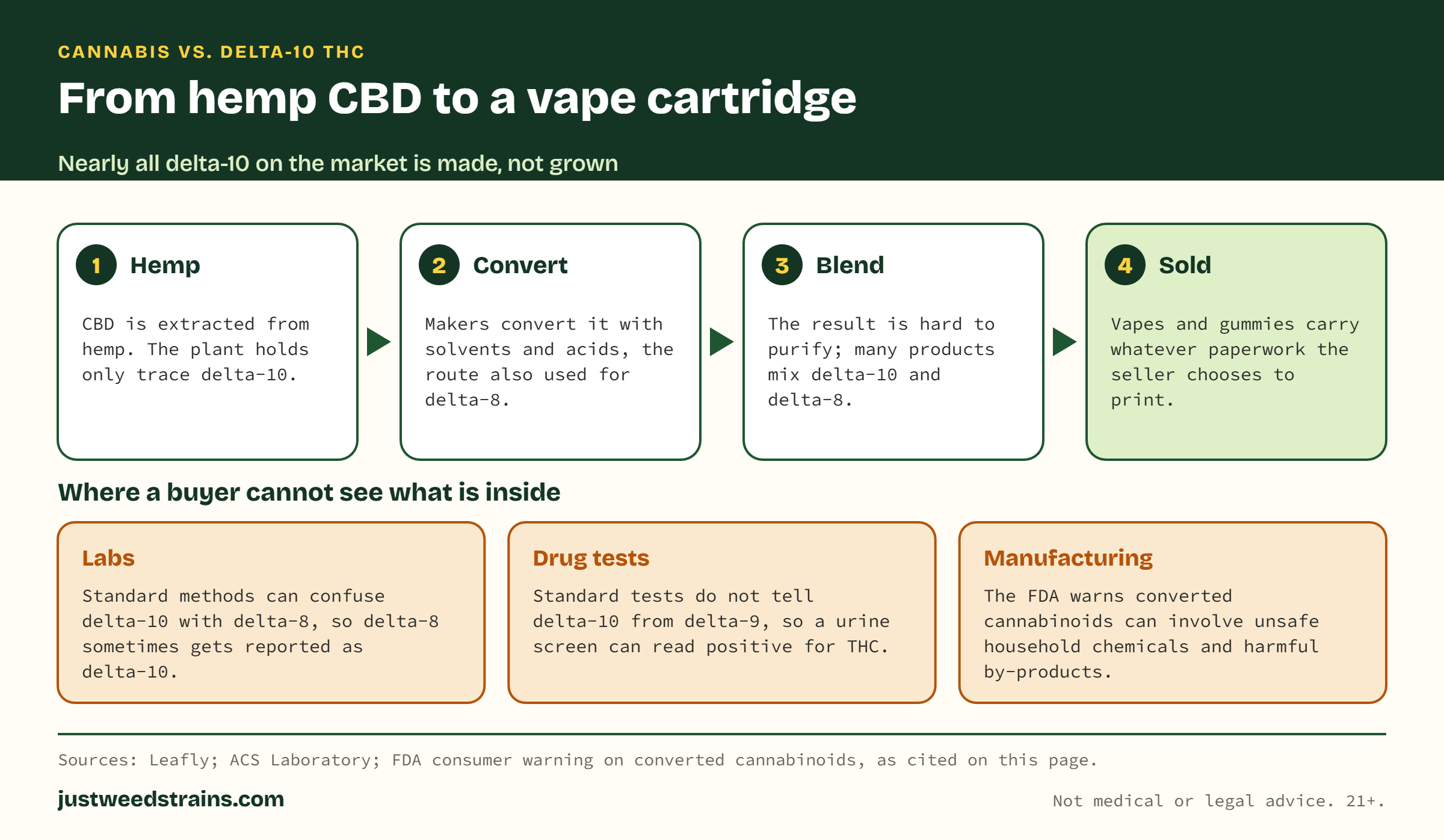
Cannabis and hemp do contain delta-10, but in amounts too small to extract and sell. The delta-10 in a vape cartridge or a gummy started as CBD from hemp and was converted with solvents and acids, the same general route used for delta-8. Leafly’s explainer adds that delta-10 is hard to purify. It quotes Roger Brown, the chief executive of ACS Laboratory, who says he does not believe any label claiming 99 percent delta-10, and it notes that many products are blends of delta-10 and delta-8.
How the effects compare
There is very little to go on here, and most of what you will read online is sellers quoting each other. No controlled human study compares delta-10 with delta-9.
What exists is anecdote. Leafly calls delta-10 much less potent than delta-9 and says users describe it as more energizing than delta-8. It is clear that those descriptions do not come from research. ACS Laboratory says delta-10 appears to be the weakest of the three and that scientists know very little about any medical use.
Delta-9 THC, the compound in dispensary flower, is the opposite case. Its effects on the brain, heart and lungs have been studied for decades, and we summarize what public health agencies say in our guide to cannabis and your organs.
What is in the product
This is the real difference for a buyer. Flower, vapes and edibles sold by New York’s licensed dispensaries have to be lab tested and labeled with their THC content. A delta-10 product bought at a smoke shop or online carries whatever paperwork the seller decided to print.
The FDA’s consumer warning on converted cannabinoids is written about delta-8, not delta-10, but it describes the same kind of manufacturing. The agency says some makers may use potentially unsafe household chemicals in the conversion, that the final product can contain harmful by-products, and that production may happen in uncontrolled or unsanitary settings.
Testing does not always settle it. ACS Laboratory says delta-10 is close enough in structure to delta-8 and a few other cannabinoids that standard lab methods can confuse them, and that delta-8 sometimes gets reported as delta-10.
Is delta-10 legal in New York?
No. New York regulates hemp products under its Cannabinoid Hemp Program, and the product rules in 9 NYCRR 114.8 say a hemp product may not contain synthetic cannabinoids or “cannabinoids created through isomerization”. The regulation gives delta-8 and delta-10 THC as its examples.
That has not kept the products off shelves. As our guide to delta-8 in New York explains, smoke shops and gas stations have gone on selling converted cannabinoids while the Office of Cannabis Management works through enforcement store by store.
Cannabis itself is legal in New York for adults 21 and over, who can possess up to three ounces of flower. It has to be bought from a licensed shop to come with the testing and labeling. Our license checker will tell you whether a store is on the state list, and our NYC dispensary directory lists the licensed ones by borough.
The federal picture
Delta-10 has been sold nationally on the theory that anything derived from hemp is legal under the 2018 Farm Bill, which defined hemp by its delta-9 content alone. Congress rewrote that definition in November 2025. The new version caps a finished hemp product at 0.4 milligrams of total THC per container and takes effect in late 2026. Any delta-10 vape or gummy with a noticeable dose holds many times that amount. Our explainer on the federal hemp ban covers the dates and the exceptions.
Drug tests
A product sold as legal hemp can still cost you a job. ACS Laboratory says standard drug tests do not tell delta-10 apart from delta-9, so a urine screen can come back positive for THC.

Which one makes sense?
In New York the comparison is mostly academic, because one of the two is legal and tested and the other is neither. If what appeals about delta-10 is its reputation for a lighter effect, a low dose of a licensed product gets you there with a label you can check. Our THC calculator converts a label percentage into milligrams, and the NYC strains database shows the labeled THC for every flower strain we found on 32 licensed menus.
Frequently asked questions
Is delta-10 the same as weed?
No. Delta-10 THC is a single cannabinoid, a close chemical relative of the delta-9 THC that makes cannabis intoxicating. The plant makes it only in trace amounts, so the delta-10 in vapes and gummies is manufactured by converting CBD extracted from hemp.
Is delta-10 stronger than delta-9 THC?
No, by every account available. Leafly describes delta-10 as much less potent than delta-9, and ACS Laboratory says it appears to be the weakest of delta-8, delta-9 and delta-10. No controlled human study has measured the difference.
Is delta-10 legal in New York?
No. New York’s cannabinoid hemp regulation, 9 NYCRR 114.8, bars hemp products from containing cannabinoids created through isomerization and names delta-8 and delta-10 as examples. Licensed dispensaries sell delta-9 THC products.
Will delta-10 show up on a drug test?
It can. ACS Laboratory says standard drug tests do not tell delta-10 apart from delta-9, so a urine test can come back positive for THC.
Is delta-10 natural or synthetic?
Both descriptions get used. The molecule occurs naturally in cannabis in trace amounts, but commercial delta-10 is made in a lab by chemically converting hemp-derived CBD. New York’s rules treat it as a converted cannabinoid and ban it on that basis.
Sources
- 9 NYCRR 114.8, Cannabinoid hemp product requirements (Cornell Legal Information Institute)
- FDA, 5 Things to Know about Delta-8 Tetrahydrocannabinol
- Leafly, What is delta-10?
- ACS Laboratory, What is delta-10 THC?
- NY Office of Cannabis Management, adult-use information
Updated Oct 10, 2026: this article was rewritten. The earlier version compared terpene profiles and receptor activity for delta-10 in a table with no source behind it, and described growing delta-10 as if it were a crop. Those sections are gone.
For adults 21 and over. This page is general information, not legal or medical advice.

The Just Weed Strains editorial team writes our strain profiles and consumer guides. Strain profiles summarize publicly available information, including breeder and dispensary descriptions. Effects vary from person to person, and nothing on this site is medical advice.