
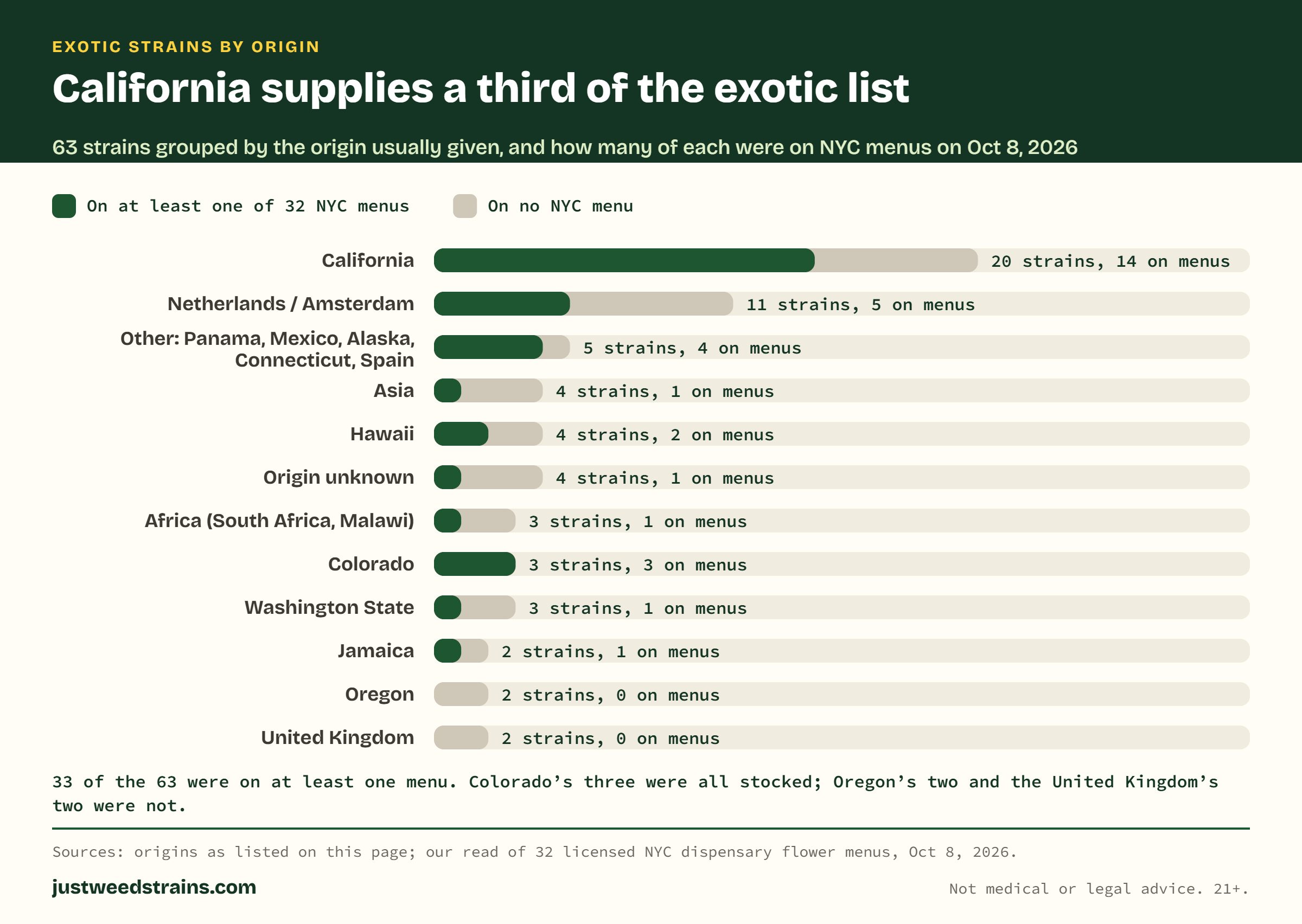
“Exotic” is cannabis slang, not a category with rules. Leafly’s glossary describes it as an informal label for potent, top-shelf flower that is rare in a given region, and often a marketing term. This page lists 63 strains that get called exotic, from landrace sativas such as Durban Poison and Malawi Gold to modern dessert crosses such as Gelato and Tropicana Cookies, with the origin usually given for each. We also checked every name against the 32 licensed New York City dispensary menus we read on Oct 8, 2026: 33 of the 63 were on at least one.
Exotic strains at a glance
| What exotic means | Slang for rare, potent, top-shelf cannabis. There is no official definition |
|---|---|
| Also called | Zaza |
| Strains on this list | 63 |
| On NYC menus | 33 of the 63, on Oct 8, 2026 |
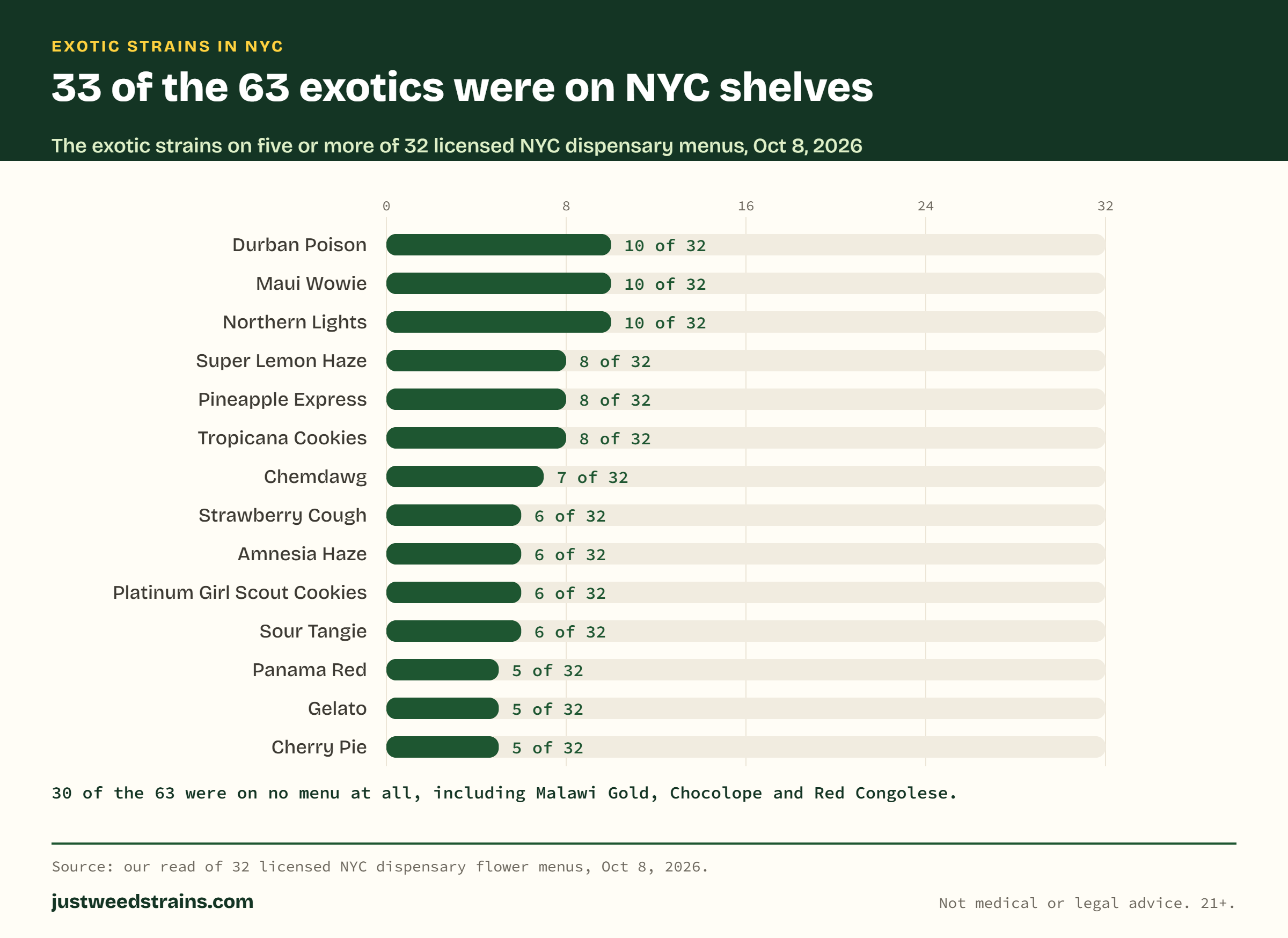
| Most stocked in NYC | Durban Poison, Maui Wowie and Northern Lights, on 10 of 32 menus each |
| Not on any NYC menu | 30 of the 63, including Malawi Gold, Chocolope and Red Congolese |
NYC figures come from our read of 32 licensed dispensary flower menus on Oct 8, 2026. See how we built the dataset. Page updated Oct 10, 2026.
What makes a strain exotic?
Nothing formal. In everyday use it means flower that is imported, unusual or simply better than what is around, and it has drifted into marketing. Leafly notes that what counts as exotic depends on who is using the word and where, and that it is often attached to strong strains whose lineage is unclear.
That makes rarity relative. Durban Poison, a South African sativa with an old exotic reputation, was on 10 of the 32 NYC menus we read in October 2026, and so were Maui Wowie and Northern Lights. Other names on this list, such as Malawi Gold and Red Congolese, were not on any of them. So treat exotic as a description of scarcity where you live, and read the label for everything else.
63 exotic strains and where they come from
The origins below are the ones usually given for each strain. For most older names they come from growers’ accounts and are not documented. Strain names link to our NYC database where the strain was on a menu.
- Durban Poison (South Africa; on 10 of 32 NYC menus): A landrace sativa named for the South African port city. The smell is sweet with a licorice edge, and it is one of the two parents of Girl Scout Cookies.
- Chocolope (Amsterdam; not on NYC menus): DNA Genetics bred it from Chocolate Thai and Cannalope Haze. The cocoa and coffee note in the smell is where the name comes from.
- Panama Red (Panama; on 5 of 32 NYC menus): A Central American sativa that was famous in the 1960s and 1970s. It takes a long time to flower, which is the usual explanation for why commercial growers dropped it.
- Tangie (California; on 3 of 32 NYC menus): DNA Genetics’ cross of California Orange and a Skunk line. It smells like tangerine peel and has been bred into dozens of later citrus strains.
- Purple Haze (California; on 2 of 32 NYC menus): The name arrives with the 1967 Jimi Hendrix song attached. Seed sellers usually give the cross as Purple Thai and Haze, but nobody has documented an original.
- Red Congolese (Africa; not on NYC menus): A sativa sold mostly in California. Despite the name, growers have long argued over how much of it is African and how much is Mexican or Afghani.
- Mango Kush (origin unknown; not on NYC menus): The parentage is not documented. Sellers describe a cross of a Mango line and Hindu Kush, and the selling point is a ripe mango smell.
- Hawaiian Snow (Hawaii; not on NYC menus): A haze cross from Green House Seeds in Amsterdam. Like most hazes it is slow to finish, and the flavor leans citrus and spice.
- Afghan Kush (Afghanistan; on 1 of 32 NYC menus): An indica type from the mountains along the Afghanistan and Pakistan border, where plants like it have been grown for hash for generations. Earthy and heavy.
- Lamb’s Bread (Jamaica; on 1 of 32 NYC menus): Also written Lamb’s Breath. A Jamaican sativa that Bob Marley is said to have favored, which has done more for its reputation than any lab result.
- Malawi Gold (Malawi, Africa; not on NYC menus): A landrace sativa from southeast Africa. Traditionally it was cured wrapped in leaves, in tight bundles called cobs.
- Green Crack (California; on 2 of 32 NYC menus): Originally sold as Cush. The story goes that Snoop Dogg gave it the new name, and some shops still label it Green Cush to avoid the word crack. Fruity, close to mango.
- Kali Mist (Amsterdam; not on NYC menus): A Serious Seeds sativa from the 1990s. Light, airy flower and a long flowering time, so nobody will mistake it for a modern dessert strain.
- Acapulco Gold (Mexico; on 4 of 32 NYC menus): A Mexican sativa from the hills around Acapulco, known in the United States since the 1960s. The name refers to the gold-brown color of the cured flower.
- Black Cherry Soda (California; not on NYC menus): Named for its taste and its dark purple color. The parents are unknown.
- Alaskan Thunder Fuck (ATF) (Alaska; on 1 of 32 NYC menus): Tied to the Matanuska Valley north of Anchorage and also sold as Matanuska Thunder Fuck. The origin stories are colorful and unverified.
- Strawberry Cough (Connecticut; on 6 of 32 NYC menus): A sativa with a ripe strawberry smell, popularized by the grower Kyle Kushman. We cover it in full in our Strawberry Cough guide.
- Maui Wowie (Hawaii; on 10 of 32 NYC menus): A Hawaiian sativa from the 1960s and 1970s with a pineapple sweetness. It ties with Durban Poison and Northern Lights as the most stocked name from this list in NYC.
- Hash Plant (Netherlands; on 1 of 32 NYC menus): An Afghani-type indica that Sensi Seeds developed in the Netherlands. Short, fast to flower and resinous, as the name promises.
- G13 (origin unknown; not on NYC menus): The legend says it escaped from a government research farm in Mississippi in the 1970s. There is no evidence for that, and the story has outlived every attempt to debunk it. An indica.
- Blueberry Kush (Oregon; not on NYC menus): Blueberry crossed with OG Kush, by most accounts. A berry smell over a kush base.
- White Russian (Netherlands; not on NYC menus): Serious Seeds made it by crossing two of the best known Dutch strains of the 1990s, AK-47 and White Widow.
- Lemon Haze (Amsterdam; not on NYC menus): Usually given as Lemon Skunk crossed with Silver Haze. It smells like fresh lemon peel, and it is one of the six strains on our giggly list that Leafly reviewers do tag as giggly.
- Purple Urkle (California; not on NYC menus): A California indica with a grape smell, linked to Humboldt County. It is one parent of Granddaddy Purple.
- Amnesia Haze (Netherlands; on 6 of 32 NYC menus): A Dutch coffeeshop staple. Citrus and earth, with a very long flowering time.
- Cinderella 99 (C99) (Netherlands; on 2 of 32 NYC menus): Bred by Mr. Soul of Brothers Grimm. The story is that it began with seeds found in a bud bought at an Amsterdam coffeeshop. Pineapple smell, quick to flower.
- Platinum Girl Scout Cookies (California; on 6 of 32 NYC menus): A cut of Girl Scout Cookies, the OG Kush and Durban Poison cross, selected for its heavy frost.
- Tahoe OG Kush (California; on 2 of 32 NYC menus): An OG Kush cut that takes its name from Lake Tahoe. Pine, lemon and fuel.
- Sour Tangie (California; on 6 of 32 NYC menus): DNA Genetics crossed East Coast Sour Diesel with Tangie. The smell is half fuel, half orange.
- Chemdawg (Colorado; on 7 of 32 NYC menus): The parent or grandparent of Sour Diesel and OG Kush, depending on whose account you trust. Its own origin story involves seeds from a pound bought at a 1991 Grateful Dead show. Our Sour Diesel guide shows how tangled that history is.
- Super Lemon Haze (Netherlands; on 8 of 32 NYC menus): Green House Seeds’ cross of Lemon Skunk and Super Silver Haze. On 8 NYC menus, it is the easiest haze from this list to find in the city.
- Black Widow (Netherlands; not on NYC menus): Mr. Nice Seedbank’s version of the Brazilian and South Indian cross better known as White Widow.
- LSD (Netherlands; not on NYC menus): A Barney’s Farm hybrid of Mazar and Skunk #1. The name is marketing. The strain has nothing to do with the drug.
- Cannatonic (Spain; not on NYC menus): Bred by Resin Seeds in Spain and one of the first strains selected for high CBD and low THC. Not what most people mean by exotic, but rare enough on a shelf.
- Grape Ape (California; on 2 of 32 NYC menus): Mendocino Purps, Skunk and Afghani in one plant, according to seed sellers. Compact purple flower and a grape candy smell.
- Jamaican Dream (Jamaica; not on NYC menus): A sativa from the Spanish breeder Eva Seeds, built on Jamaican genetics.
- Golden Goat (Colorado; on 1 of 32 NYC menus): Usually described as an accident: a male plant pollinated its neighbor in a Kansas grow room, and the result later became a Colorado dispensary regular.
- Chernobyl (Washington State; not on NYC menus): A TGA Subcool Seeds cross involving Trainwreck, Jack the Ripper and Trinity. It smells like lime sherbet.
- Gelato (California; on 5 of 32 NYC menus): Sunset Sherbet crossed with Thin Mint GSC, out of the Bay Area. It is the parent of a long line of dessert-named strains, including Jealousy.
- Pineapple Express (Hawaii; on 8 of 32 NYC menus): Most people know the name from the 2008 film. Sellers give the cross as Trainwreck and Hawaiian.
- Red Dragon (Asia; not on NYC menus): Barney’s Farm bred it in Amsterdam from a Himalayan kush and a Brazilian sativa.
- Trainwreck (California; on 3 of 32 NYC menus): A Northern California hybrid tied to Humboldt County, with Mexican, Thai and Afghani ancestry by most accounts. Pine and lemon.
- Blue Cheese (United Kingdom; not on NYC menus): Blueberry crossed with UK Cheese. It smells exactly the way the name says, and people either like that or they do not.
- Northern Lights (Netherlands; on 10 of 32 NYC menus): An Afghani indica that reached the Netherlands from the US Pacific Northwest in the 1980s and went on to parent a long list of hybrids.
- Alien OG (California; on 1 of 32 NYC menus): Tahoe OG crossed with Alien Kush.
- Golden Pineapple (origin unknown; on 1 of 32 NYC menus): Listed as Golden Goat crossed with Pineapple Kush.
- Orange Crush (California; not on NYC menus): Listed as California Orange crossed with Blueberry. Sweet, close to tangerine.
- Afghan Hawaiian (Hawaii; not on NYC menus): As the name says, a cross of Afghani and Hawaiian lines. No breeder is documented.
- Pineapple Chunk (United Kingdom; not on NYC menus): A Barney’s Farm hybrid that combines a Pineapple line with Cheese and Skunk #1.
- Bruce Banner (Colorado; on 3 of 32 NYC menus): OG Kush crossed with Strawberry Diesel by Dark Horse Genetics. The #3 cut made its name on high lab results in Colorado, and it is a parent of Solomon Grundy.
- Cherry Pie (California; on 5 of 32 NYC menus): Granddaddy Purple crossed with Durban Poison, from the Bay Area. Also on our giggly list.
- Jillybean (Oregon; not on NYC menus): Orange Velvet crossed with Space Queen, from TGA Subcool Seeds. A candy orange smell.
- Granddaddy Purple (California; on 3 of 32 NYC menus): Introduced in the Bay Area in 2003 by the grower Ken Estes. Purple Urkle and Big Bud are the parents.
- Cinex (Washington State; not on NYC menus): Cinderella 99 crossed with Vortex. Citrus and skunk.
- Blueberry Cheesecake (origin unknown; not on NYC menus): Blueberry and Cheese lines, crossed by more than one seed company under the same name, so the plant varies.
- Tropicana Cookies (California; on 8 of 32 NYC menus): Girl Scout Cookies crossed with Tangie, bred by Oni Seed Co. Purple flower with a strong orange smell.
- Exotic Thai (Thailand; not on NYC menus): Less a single strain than a label for Thai-descended sativas. Expect long, thin flower and a spicy smell.
- Purple Tangie (California; on 1 of 32 NYC menus): A purple Tangie cross or selection. The exact parents depend on the grower.
- Hindu Kush (Pakistan; not on NYC menus): The landrace indica of the mountain range between Afghanistan and Pakistan, and the source of the word Kush in so many strain names.
- Lemon Meringue (Washington State; on 2 of 32 NYC menus): An Exotic Genetix cross of Lemon Skunk and Cookies and Cream.
- Mendocino Purps (California; not on NYC menus): A Mendocino County plant that was passed around as a cutting before it was sold as seed. Berry smell, deep purple.
- Alien Dawg (California; not on NYC menus): Chemdawg crossed with Alien Technology. Sour and heavy on fuel.
- Gelato Cake (California; not on NYC menus): Gelato #33 crossed with Wedding Cake.
Exotic strains on NYC menus right now
These are the names from the list that were on at least 5 of the 32 licensed NYC dispensary menus we read on Oct 8, 2026, with the menu price where it was sold by the eighth:
- Durban Poison: 10 of 32 menus, $25 to $56 per eighth
- Maui Wowie: 10 of 32 menus, $30 to $47 per eighth
- Northern Lights: 10 of 32 menus, $30 to $40 per eighth
- Pineapple Express: 8 of 32 menus, $35 to $40 per eighth
- Super Lemon Haze: 8 of 32 menus, $27 to $50 per eighth
- Tropicana Cookies: 8 of 32 menus, $22 to $40 per eighth
- Chemdawg: 7 of 32 menus, $32 to $35 per eighth
- Amnesia Haze: 6 of 32 menus, $30 to $32 per eighth
- Platinum Girl Scout Cookies: 6 of 32 menus, $42 to $50 per eighth
- Sour Tangie: 6 of 32 menus, $30 to $44 per eighth
- Strawberry Cough: 6 of 32 menus, $32 to $42 per eighth
- Cherry Pie: 5 of 32 menus, $24 to $43 per eighth
- Gelato: 5 of 32 menus, $22 to $45 per eighth
- Panama Red: 5 of 32 menus, $30 to $40 per eighth
The full dataset, 1,033 strain names with the shops that carry each, is in our NYC weed strains database. Menus change daily, so confirm with the shop before you travel.
Buy only from a licensed shop. Our license checker looks up any store by name, street or ZIP against the state list, the Office of Cannabis Management has its own verification page, and our NYC dispensary directory lists every licensed shop by borough.
Exotic strains FAQ
What does exotic weed mean?
Exotic is slang, not an official category. Leafly’s glossary describes it as an informal label for potent, top-tier cannabis that is rare in a given region, and notes it is often used as a marketing term.
Is exotic weed stronger?
Not necessarily. The word is associated with potent flower, but there is no standard behind it. The THC percentage on the label is the only reliable guide to strength.
What is zaza?
Zaza is another slang word for exotic: rare, high-end cannabis. Like exotic, it has no fixed definition.
Which exotic strains can I buy in NYC?
Of the 63 strains on this list, 33 were on at least one of the 32 licensed NYC dispensary menus we read on Oct 8, 2026. Durban Poison, Maui Wowie and Northern Lights were the most stocked, on 10 menus each.
What is the most famous exotic strain?
There is no agreed answer. Older landrace names such as Durban Poison, Acapulco Gold and Panama Red built the idea of exotic cannabis, while modern lists lean on dessert crosses such as Gelato.
More strain guides
- The most popular weed strains in NYC dispensaries: the 21 most stocked names, counted menu by menu.
- Weed strains that make you giggly: which names reviewers tag as giggly, and which of them NYC shops stock.
- Sour Diesel: the city signature, and the most argued-over origin story in cannabis.
- Strawberry Cough: the sweetest of the East Coast classics.
- Jealousy: the Seed Junky hybrid behind Permanent Marker, and a Leafly Strain of the Year.
Sources
- Leafly cannabis glossary, Exotic
- Just Weed Strains, NYC weed strains database (32 licensed dispensary menus, read Oct 8, 2026)
Updated Oct 9, 2026: this list was first published in 2023 as a top 50. It has 63 entries, so we renamed it, removed the ranking claim and added New York City availability. On Oct 10, 2026 we rewrote the strain descriptions and corrected the listed origin of Black Widow and Lemon Meringue.
For adults 21 and over. Nothing on this page is medical advice. Our New York cannabis guide covers the current rules.

The Just Weed Strains editorial team writes our strain profiles and consumer guides. Strain profiles summarize publicly available information, including breeder and dispensary descriptions. Effects vary from person to person, and nothing on this site is medical advice.